Tuesday, 5 April 2022

Round

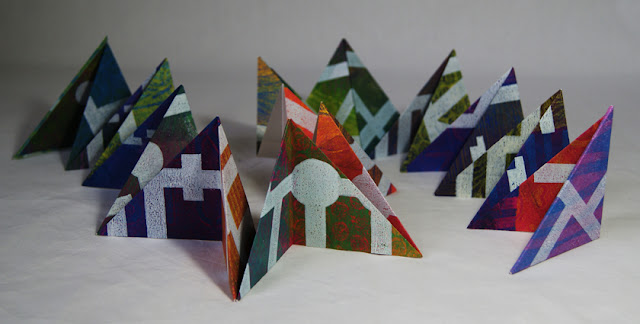
Because the only lightweight paper I had for scroll pages was Chinese calligraphy paper (which while it drapes beautifully its lack of sizing means it’s difficult to work on) I played with the whirlwind and dragon scale books adapting the structures to a more western style of bonding. 


 Please ignore the colours they were chosen to show up on a zoom workshop.

I especially liked the whirlwind and thought it would work for the NWBA theme of ‘Round’.

I played with monoprints and labyrinths as a motif to give the books content but I'm not happy with them yet.

Though I did turn one into a paper orb

Sunday, 20 March 2022

Dragons and whirlwinds

 Having seen an amazing set of books by Zhang Xiaodong (on a link posted on the MBAG Facebook page). I've been experimenting with dragons scale and whirlwind stuctures 


Now to think about images.


Sunday, 20 February 2022

Lines

 The challenge for #areyoubookenough this month is ‘lines’.

I had what I thought was a quick and simple idea. After two weeks of making sheets and sheets and sheets  of lines, writing with various different implements, paints, inks and surfaces I finally ended up with these.


 The quote is Paul Klee from his Pedagogical Sketchbook.

Monday, 14 February 2022

Inspired by

For Christmas one of my daughters gave me a Paul Johnson Book. 

 I was fascinated by its construction. The pages are made from a single sheet of paper cut to give 8 panels and folded to give 5 pages.

I worked out the cuts needed for each panel

 And played with altering the shapes of the basic rectangles needed to make the folded structure 

 And tried it cutting a piece of gelli printed paper to give three pages

 I wanted to keep the chunky feel of the thick spine that Paul Johnson used but instead of a single folded sheet stuck to the spine with a couple of flaps I didn’t want to use glue and I wanted my panels cut in pairs (so three separate pieces) .

I liked it but decided to change to format to a square

 Looking through the holes in the pages to the sheets behind it put me in mind of a maze or hedge. So I thought about making the cuts spikier. 

 The gelli printed paper is not good at holding a crisp fold over time so I thought I’d experiment with making double sided paste paper in appropriate colours. 

 
 I think they worked. 

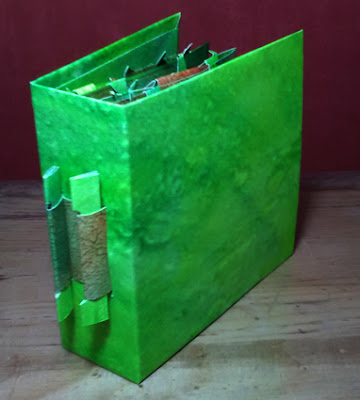
 I covered thin card with more paste paper. I would have liked something more substantial but the binding method I concocted needs thin slits cutting into the spine and I thought the thin card might be neater

And I bound the pages. The double spreads wanted to splay open which spoiled the hedge effect I was after so I held them shut with a thin strip of paper slotted over the fore edge.

I have written the words and even managed to get to Hot Bed Press to typeset them. They need living with for a few days before I go back and print them for an edition.I also need to make a whole stash of paste papers.

There’s a lot of work in each of these books so I’m thinking probably an edition of 5

Monday, 31 January 2022

From Bed to Book

When we resumed our meetings after lock down one of the NWBA members suggested the theme for the next set of books should be our journey to get there. I admit I was sceptical about it at first.

But on the way home I realised that medieval strip maps gave the same view of the world as sat navs – you go in a straight line and everything else, rivers, junctions, etc, is an adjunct to that.

 I developed a diagrammatic record of the journey from my bed to the room in the library where we meet. 


 I had been intending to make a scroll but when experimenting with structures for a different project I realise that an accordion folded triangular book would take this straight journey and make it go round corners and up and down hills.

It is essentially a long acrylic monoprint and is a bit springy. So it needs keeping in a slip case. 


Monday, 24 January 2022

More Dragons

 Although I finished it before Christmas I realised that I hadn’t photographed the finished dragon book. 

 The collagraph plate made 2 lots of separate heads, tails, and bodies facing in opposite directions. I used the Paul Johnson hinge method of attaching the pieces together. It may be a fiddly way of making what is essentially an accordion book but it means that there are no folds which can wear over time.